Stories
What 210 evacuations taught me about being present
Between March and the months that followed I helped move more than 210 people out of danger. The thing that mattered most was never the van, the fuel or the route.
The interview this came from
Michael Daniel Sagatis · English
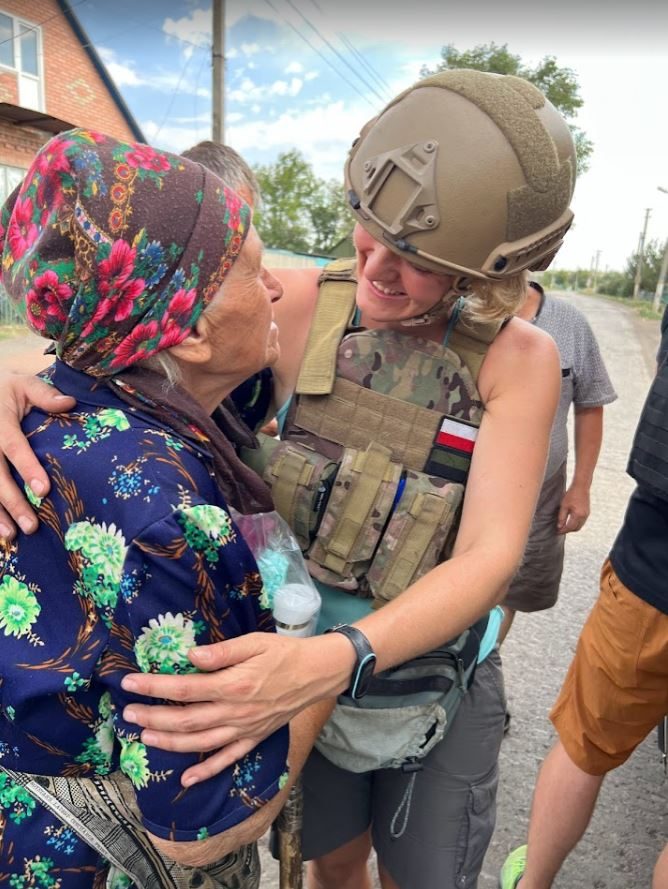
In the first weeks of the invasion I helped move more than 210 people along the Lviv route. Then came the first humanitarian transport into Kyiv, then three convoys into Kharkiv, then months in the Donbas — food with World Central Kitchen, an ambulance delivered with Be A Hero UA, water purification tablets with UAid Direct. Near the end there was a ninety-one-year-old man in a front-line town who needed to leave and had no way to.
People assume the hard part of that work is logistics. It is not. Logistics is solvable. You find fuel, you find a vehicle, you learn which roads are open today.
The hard part is the four minutes in the back seat
The hard part is the woman in the back seat who has just closed the door of a house she will probably never see again, and who has four minutes with you before you reach the next checkpoint and stop being able to talk.
You cannot fix anything for her in four minutes. You cannot give her the house back. You cannot promise her that her son is alive. Everything a helpful person normally reaches for is unavailable.
What is left is being entirely there. Not looking at the road when she speaks. Not filling the silence because the silence is unbearable to you. Not moving her along to a more comfortable subject for your sake.
Presence is a skill, not a personality trait
I used to think being present was something warm people simply were. It is not. It is a skill, and it is mostly made of restraint — not advising, not comparing, not rescuing, not needing the other person to feel better so that you can.
Doing it several times a day for months, in conditions where you genuinely cannot fix anything, strips out every version of listening that was ever secretly about you. There is no room for it. That is a brutal way to learn, and it is the most useful thing I know.
How this shows up in a coaching session
People arrive at coaching wanting to be fixed and expecting to be advised. Advice is cheap and mostly useless — if advice worked, everyone with an internet connection would already have the life they want.
What actually moves someone is being met without being managed. Held through the doubt rather than talked out of it. Asked a question that is genuinely a question rather than a suggestion wearing a question mark.
Billy, a journalist I met in Ukraine during the first year of the war, later came to me carrying three things at once — a cancer diagnosis, a family crisis, and anxiety that never rested. We worked over weekly calls, taking apart what felt impossible to hold all at once. I did not fix any of those three things. I was not able to. What I could do was be there while he found he could carry them.
That is the whole method, and I learned it in a car.
If any of this sounded like you
You do not have to figure it out alone.